By Elena Hartwell | Updated: Dec 12, 2025
Editor’s Note (December 2025): This guide has been updated to reflect the latest fee markets and Taproot privacy standards. Our technical team, led by Ryan Mitchell, spent over 40 hours testing these multisig wallets with real funds to verify their recovery processes. We prioritize security over convenience; therefore, we only recommend open-source or auditable solutions. We do not accept payments for placement in this ranking.
If you are holding significant value in a cryptocurrency wallet with a single private key, you are relying on luck, not security. In 2025, the “single seed phrase” model is effectively obsolete for long-term storage of high-value digital assets.
Exchange hacks, phishing attacks, and physical theft all have one thing in common: they exploit a Single Point of Failure. If that one key is compromised, your funds are gone.
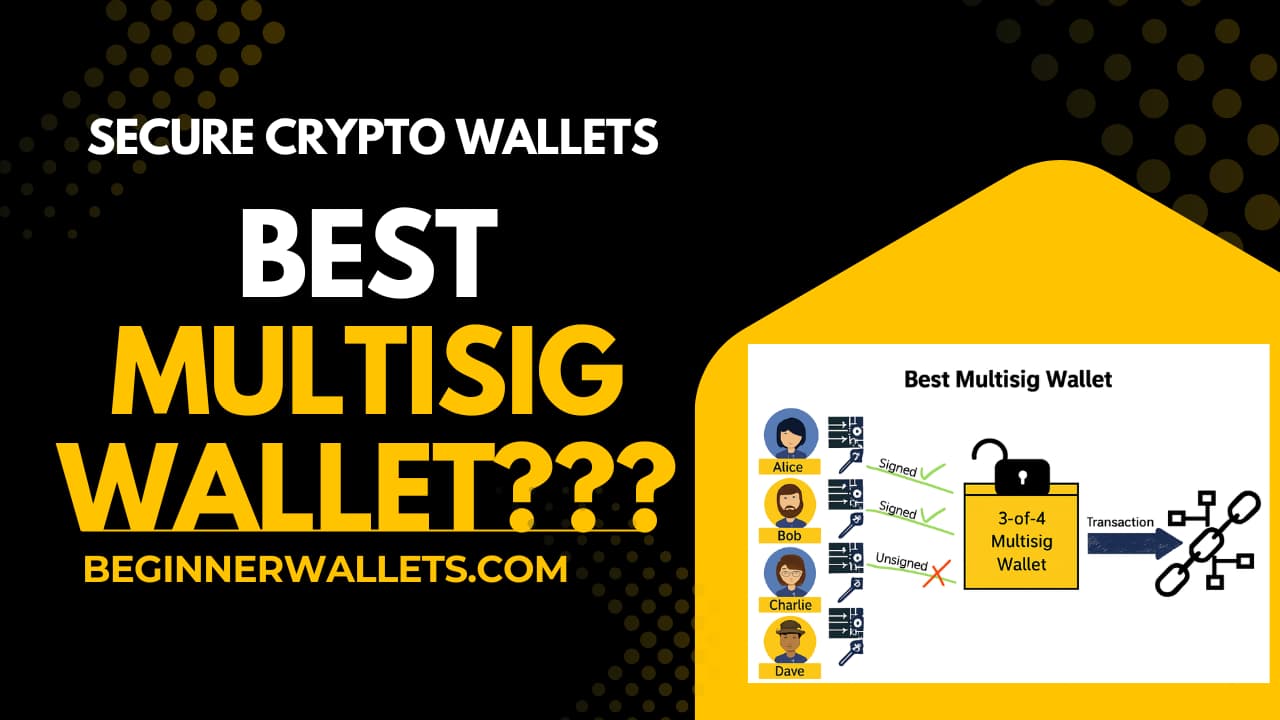
The solution used by every major exchange, custodian, and whale is the multisig wallet. By requiring consensus from multiple devices to authorize a transaction, multisig makes your wealth exponentially harder to steal and nearly impossible to lose.
In this comprehensive guide, we reviewed the top solutions on the market to help you find the best multisig wallets for your portfolio.
Quick Verdict: Top Picks at a Glance
| Best For… | Winner | Why? |
|---|---|---|
| Bitcoin Sovereignty (DIY) | Sparrow Wallet | Best interface, supports air-gapped devices, Tor built-in. |
| Ethereum & DeFi | Safe (Gnosis) | The industry standard smart contract wallet. $100B+ secured. |
| Beginners (Concierge) | Casa | Easiest UX. Impossible to make a mistake. |
| Old School / Low Spec | Electrum | Lightweight, battle-tested, runs on anything. |
| IRA / Tax Services | Unchained | Excellent multisig + financial services (loans, IRA). |
What is a Multisig Wallet? (And Why You Need It)
A standard crypto wallet is like a house key: whoever holds the key opens the door.
A multi-signature wallet is like a nuclear launch sequence: it requires multiple keys to turn simultaneously.
The “2-of-3” Standard
The most common setup is “2-of-3”. You create 3 distinct keys:
- Key A (Home): Stored in your safe.
- Key B (Bank): Stored in a safety deposit box.
- Key C (Office/Relative): Stored in a geographically separate location.
The Security Math:
- Theft Protection: If a thief breaks into your home and steals Key A, they cannot move your funds. They still require multiple keys to sign the transaction.
- Loss Protection: If your house burns down and destroys Key A, you do not lose your money. You can simply go to the bank and office to recover your wallet using Keys B and C.
This structure eliminates the risk of a single point of failure, which is the primary weakness of traditional storage methods.
The 5 Best Multisig Wallets in 2025 (In-Depth Review)
1. Sparrow Wallet (Best for Bitcoin DIY)
- Supported Assets: Bitcoin (BTC) Only
- Price: Free (Open Source)
- Platform: Desktop (Windows, Mac, Linux)
Sparrow has rapidly become the favorite bitcoin wallet for power users. It is not just a wallet; it is a coordinator. It doesn’t hold your keys; instead, it connects to your hardware wallet (like Ledger(Links may be affiliate links), Trezor(Links may be affiliate links), or Coldcard) to build the transaction.
Why We Love It:
Sparrow offers an incredible balance of power and usability. It visually shows you exactly how your multisig wallet is constructed. It also strongly encourages Air-Gapped workflows, keeping your private key physically isolated from the internet.
Pro Tip: When setting up your wallet in Sparrow, choose the Taproot (P2TR) script type if your hardware supports it. This makes your multi-signature transactions cheaper and more private.
2. Safe (formerly Gnosis Safe) (Best for Ethereum)
- Supported Assets: Ethereum, ERC-20, NFTs
- Price: Free (Network Gas Fees apply)
- Platform: Web, Mobile
If you hold Ethereum, USDT, or high-value NFTs, Safe is the gold standard. Unlike a bitcoin wallet which uses native script, Safe uses a Smart Contract to manage your security.
Why We Love It:
Safe acts as an “App Store” for your crypto. You can install modules to set spending limits or automate inheritance. It is a highly versatile wallet provider that integrates seamlessly with DeFi protocols like Aave and Uniswap.
- Pros: Bank-grade security for EVM chains; massive DeFi integration.
- Cons: Deploying the wallet costs gas fees.
3. Casa (Best for Beginners)
- Supported Assets: Bitcoin, Ethereum
- Price: ~$250/year (Gold Plan)
- Platform: Mobile App
Casa solves the biggest problem with multi-signature: Complexity. Managing 3 seed phrases on your own is stressful. Casa uses a “Collaborative Custody” model where you hold 2 keys and they hold 1 key.
Why We Love It:
It feels like using a regular banking app. If you lose one of your hardware keys, you don’t need to panic. You just call Casa, and they use their recovery key to help you move your funds to a new wallet. This unique approach enhance security without adding stress.
4. Electrum (The Reliable Classic)
- Supported Assets: Bitcoin Only
- Price: Free (Open Source)
- Platform: Desktop, Android
Electrum has been around since 2011. It isn’t pretty, but it is bulletproof. It was one of the first crypto wallets to support multi-signature and remains a favorite for users with older computers.
Why We Love It:
It is lightweight software that runs locally on your machine. It is perfect for setting up a multisig wallet on an old, offline laptop. While the interface is dated, the underlying code is trusted by the entire crypto community.
5. Unchained (Best for Financial Services)
- Supported Assets: Bitcoin Only
- Price: Free tier available
- Platform: Web
Unchained is similar to Casa but focuses on financial services. Because they hold one key, they can verify your assets exist without moving them, allowing them to offer wallet offers like loans or IRAs backed by your bitcoin.
Why We Love It:
For US-based investors, Unchained provides excellent “Concierge Onboarding.” They will get on a video call and walk you through every step of setting up your hardware wallet and vault.
Technical Risks: What You Must Know
Before you set up your first vault, you need to understand how this wallet works differently from a standard one.
1. The Backup Trap (Critical)
In a single-sig wallet, the seed phrase is all you need. In a multi-signature wallet, saving your seed phrases is NOT enough. You must also save your “Output Descriptor” (a file that Sparrow/Electrum generates). Without this map, your keys are like puzzle pieces with no picture guide—you might have the keys but still cannot build the wallet to spend the funds.
2. Transaction Fees
Security comes at a price. A multi-signature transaction occupies more block space than a standard one. This means your transaction fees will be roughly 2x to 3x higher. Keep this in mind if you are securing smaller amounts of crypto assets.
Step-by-Step: Setting Up a DIY 2-of-3 Vault
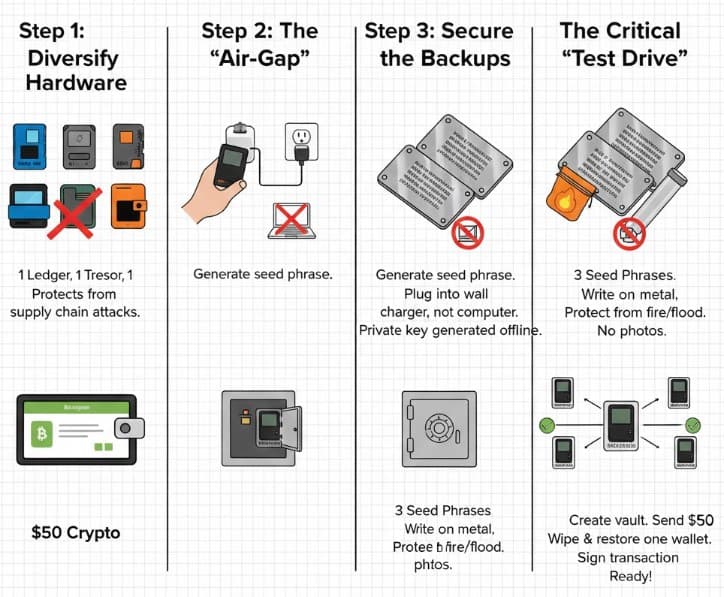
If you choose the DIY route (Sparrow or Electrum), here is the workflow to enhance security effectively.
Step 1: Diversify Hardware
Do not buy 3 Ledger Nanos. If Ledger has a firmware bug, all 3 keys are at risk. The ideal wallet setup involves 1 Ledger, 1 Trezor, and 1 Coldcard. This protects you from supply chain attacks on any single manufacturer.
Step 2: The “Air-Gap”
When generating your seed phrases, plug your hardware wallet into a wall charger, not your computer. This ensures your private key is generated offline.
Step 3: Secure the Backups
You will now have 3 Seed Phrases. Do not store them together. Do not take a photo of them. Write them on metal to protect your digital asset backups from fire or flood.
Step 4: The Critical “Test Drive”
Create your vault. Send $50 worth of crypto to it. Now, wipe one of your hardware wallets. Yes, wipe it. Then restore it using your seed phrase and try to sign a transaction. If you can do this, you are ready for the big leagues.
Frequently Asked Questions (FAQ)
Is a multisig wallet safe if I lose one key?
Yes! In a standard 2-of-3 setup, you can still access and move your funds with the remaining 2 keys. You should immediately create a new wallet and move funds to it.
Can I use Multisig with a Ledger Nano S?
Absolutely. Ledger, Trezor, and Coldcard all support multi-signature. The wallet software (like Sparrow) coordinates them.
What are the main use cases for multisig?
Beyond personal security, use cases include business treasuries (requiring CEO + CFO to sign), inheritance planning, and escrow services.
Conclusion
Upgrading to a multisig wallet is the moment you graduate from a casual user to your own bank manager.
For most people, the decision comes down to support versus sovereignty. Whether you choose the guided hand of Casa or the sovereign path of Sparrow, the important step is moving away from the fragility of a single private key. Your future self will thank you for taking the time to enhance security today.
Disclaimer: This guide is for educational purposes only. Cryptocurrency involves risk. Always verify your own backups before moving significant funds.